


 Posts
Posts


I'm on an extended road trip through Pennsylvania and New York with Penelope PopUp and Ranger Rudy. My two cats, Osito and Brindie, are along for the ride. Our first stop is Hillside Campground in northeast Pennsylvania. Here's what our site looks like...
Tuesday, August 2, 2011


Wednesday, March 30, 2011
David Brooks on the Edge
I admire David Brooks, the editorial columnist for the New York Times, and I often agree with his positions even though he is a “conservative” and I am a “liberal”. What I like most about him is his intellectual integrity: He gets the facts right and his positions are built upon solid logical progression. But he really blew it this week.
In his article, “Tools for Thinking”, he attempts to summarize the results of a symposium that explored scientific notions which could improve human thinking. First up is John McWhorter, a linguist at Columbia University
He also states that the QWERTY keyboard was invented to slow typists down so that the keys of mechanical typewriters wouldn’t jam. Everything I’ve read says that the design was meant to do exactly the opposite – speed up typing by arranging the keys according to the most prevalent letter combinations in the English language. Brooks should know this and should not have passed along incorrect assertions.
He then quotes Daniel Kahneman of Princeton University
To be fair, Brooks does us a favor by introducing some of the ideas that emerged from the Edge symposium. Supervenience, the Fundamental Attribution Error, Emergent Systems, and the like are fascinating concepts, none of which I had ever heard of before. Understanding why we think the way we do is always a useful pursuit. But Brooks above all is a political commentator, and when he suggests that political polarization, rising health care costs and bad marriages can be understood if we just see them as emergent systems, I suggest that he not write his columns so close to the deadline.
Friday, February 4, 2011
The New Media
I’m willing to bet that most people learned about the strife in Egypt Tibet
But what a minute. Aren’t we in the brave new world of electronic information distribution? I’ve been reading for several years now how the traditional media – broadcast news and printed newspapers – are relics from the past. People today get all their information from the online social networks.
To test this theory, I just surveyed several of the social media to develop this list of the day’s major events:
- Hulk Hogan has made a new rap video.
- Rosie Huntington ate some falafel.
- A whole lot of people have recently checked in at Starbucks.
- Overweight cats are still falling from window sills at an alarming rate.
- Men are pigs.
- It’s a great day for cashmere.
- Here in
- Everybody is discussing sexual intercourse with snow.
As I review this list I can’t escape a vague feeling that I’m still missing some of the more important events of the day. I think I’ll stick with the traditional media a little while longer, gate keeping and all.
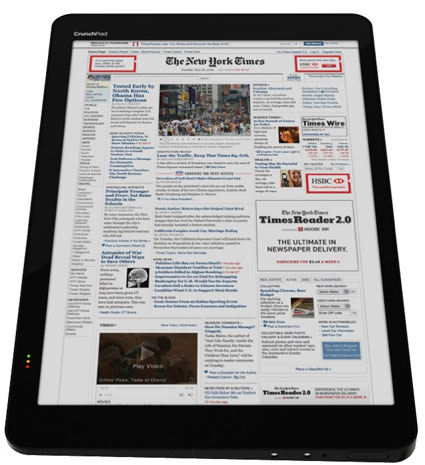
In other news, Rupert Murdock has launched a revolutionary new venture. The Daily is the first exclusively electronic newspaper and will be available as an app on the Apple iPad. But, again, wait a minute. Haven’t paper and ink newspapers been searching for a way to go electronic for the past five years? Most of the major papers already have an online edition. Some are free; some require a subscription. So what’s new about Murdock’s edition?
A newspaper on a screen is a website whether you call it a website or you call it an app. As far as I can see, there isn’t anything you can do on an iPad that you can’t do on any website except, by making it an “app”, you can limit it to a small subset of users (small in comparison to the total number of people with access to the internet). So what’s the point?
It isn’t the technology that’s revolutionary here. It’s how the money is collected. None of the major players has yet figured out how to make a dime publishing online news. By loosening it’s prohibition against subscription services in the App Store, Apple gets to grab a whopping thirty percent off the top. Murdock presumably gets to ride the wave of popularity of the iPad and the ignorance of its users. They will think that reading a newspaper on a computer screen was not possible until their magical device hit the stores. But once the novelty wears off, are people any more likely to pay for their news than they have been in the past?
Stay tuned or tweeted, as the case may be.
Subscribe to:
Posts (Atom)